



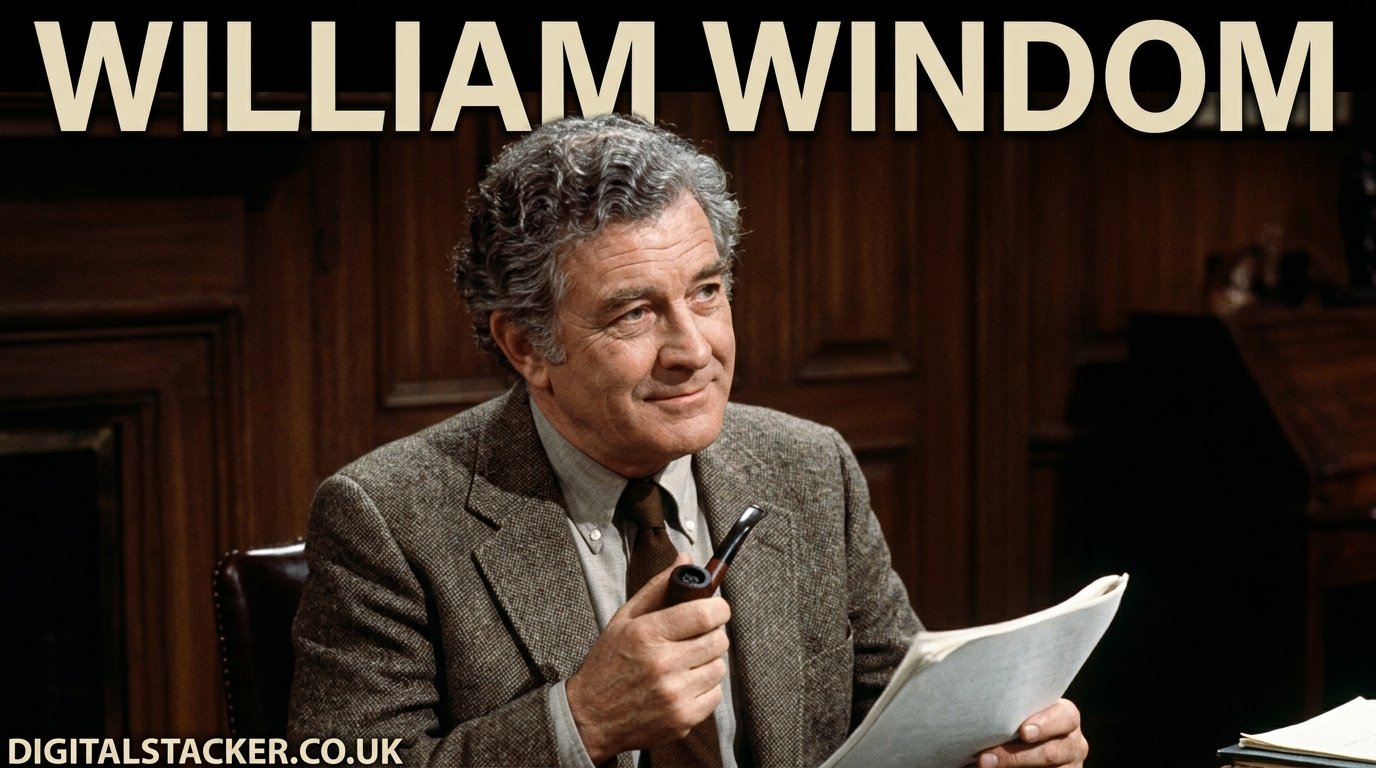
Who Was William Windom?
William Windom was an American character actor whose career spanned nearly six decades, from the early days of live television in the late 1940s to feature film work in the 2000s. Born on September 28, 1923, and passing away on August 16, 2012, at the age of 88, Windom built a reputation as one of Hollywood’s most dependable and versatile supporting performers. He rarely chased leading-man status, and he openly admitted he never considered himself a star, yet his face and voice became instantly familiar to generations of television and film audiences.
What made William Windom stand out was his range. He could play a warm, folksy small-town doctor just as convincingly as a cold-blooded killer, a blustering politician, or a grieving father. Casting directors valued him because he brought authenticity to almost any role, whether it called for comedy, drama, or something in between. Today, he is remembered most fondly for three roles in particular: Dr. Seth Hazlitt on Murder, She Wrote, Commodore Matt Decker in the classic Star Trek episode “The Doomsday Machine,” and cartoonist John Monroe in the Emmy-winning sitcom My World and Welcome to It.
For anyone researching classic American television history, William Windom’s career offers a fascinating window into how character actors shaped the golden age of TV and film. His body of work remains widely available through streaming platforms, DVD box sets, and classic television reruns, keeping his legacy alive for new audiences discovering his performances decades later.
Early Life and Family Background
William Windom was born in Manhattan, New York City, to Paul Windom, a practicing architect, and Isobel Wells Peckham. His family background carried a notable piece of American political history, since he was the great-grandson of William Windom, a nineteenth-century U.S. Congressman and Secretary of the Treasury under two different presidential administrations. The actor was named directly after his prominent ancestor, a connection he spoke about with quiet pride throughout his life.
Growing up in New York gave young William Windom early exposure to theater and the arts, an environment that would later shape his decision to pursue acting professionally. He attended Williams College in Massachusetts before his education was interrupted by the outbreak of World War II. Later, after his military service, he continued his studies at Fordham University and Columbia University in New York, broadening his intellectual foundation before fully committing to a life on stage and screen.
This blend of an academic upbringing, a distinguished family name, and a genuine early curiosity about performing arts gave Windom a grounded, thoughtful approach to his craft. Colleagues and biographers often noted that he carried himself with the demeanor of an educated, well-read man, which came through even in his most comedic or eccentric roles.
Military Service in World War II
Before William Windom became a household name in American television, he served his country during World War II. He enlisted in the U.S. Army and took part in the Army Specialized Training Program, which sent him to study at institutions including The Citadel, Antioch College, and the University of Kentucky. This program was designed to prepare soldiers for specialized military roles while continuing elements of their education.
Windom went on to become a paratrooper, joining Company B of the 1st Battalion, 508th Parachute Infantry Regiment, part of the storied 82nd Airborne Division. Serving as a paratrooper during this era placed him among some of the most physically demanding and dangerous military roles of the war, reflecting a level of discipline and courage that would later inform his commanding presence on screen.
Following the war, while stationed in Frankfurt, Germany, during the Allied occupation, Windom enrolled at Biarritz American University in France. It was here that he first became seriously involved in theater, discovering a passion that would ultimately redirect the course of his life. This wartime and post-war period was, in many ways, the true origin point of his acting career, even though the public would not see him on screen for several more years.
Path to Acting: Theater Beginnings
After returning to the United States, William Windom threw himself into the theater world, training with the American Repertory Theatre between 1946 and 1961. This company gave him his first real professional footing, and he made his Broadway debut in November 1946 appearing in a rotating repertory that included productions such as Henry VIII, What Every Woman Knows, John Gabriel Borkman, and Androcles and the Lion.
His Broadway resume grew steadily through the late 1940s, with roles in productions like Yellow Jack and a memorable turn as the White Rabbit in a staging of Alice in Wonderland. These early theatrical years were essential to his development as a performer, teaching him the discipline of live performance and giving him the versatility that would later define his television and film work.
Theater remained close to Windom’s heart even after he became known primarily for screen work. Later in his career, he created and toured with one-man shows portraying humorist James Thurber and, separately, World War II combat journalist Ernie Pyle. These solo theatrical productions allowed him to return to his stage roots and demonstrated the depth of research and craftsmanship he brought to historical and literary figures.
Breakthrough on Television and The Twilight Zone
William Windom made his television debut in 1949 on the NBC anthology series The Philco Television Playhouse, entering the industry during the earliest, experimental years of American TV. He quickly became a familiar presence on the anthology drama circuit, appearing in prestigious programs such as Studio One, Omnibus, Masterpiece Playhouse, and Kraft Television Theatre, all of which were known for showcasing serious dramatic writing and stage-trained actors.
One of his most talked-about early television roles came in 1961, when he starred in “Five Characters in Search of an Exit,” an acclaimed episode of The Twilight Zone in which he played a mysterious character known only as The Major. Windom later described this role as one of the favorites of his career, and the episode remains a fan favorite among Twilight Zone enthusiasts for its surreal, thought-provoking storyline.
Throughout the 1960s, Windom continued building his reputation as a reliable guest star, appearing in popular series such as Gunsmoke, The Donna Reed Show, Mission: Impossible, and Ironside. This steady stream of guest appearances across so many different genres helped establish him as one of the most in-demand character actors of the decade, known for delivering strong, memorable performances even in limited screen time.
Film Career and To Kill a Mockingbird
William Windom’s feature film debut came in 1962 with To Kill a Mockingbird, one of the most celebrated films in American cinema history. He played Horace Gilmer, the prosecuting attorney opposite Gregory Peck’s iconic Atticus Finch. Sharing the screen in an Academy Award-winning production early in his film career gave Windom instant credibility in Hollywood and opened doors to further film roles throughout the 1960s and beyond.
In 1968, he took on a much darker role, starring alongside Frank Sinatra in The Detective, playing a closeted, homophobic murderer. The performance drew praise from critics, including a notable mention in The New York Times, and demonstrated Windom’s willingness to take on challenging, morally complex characters rather than sticking to safe or likable parts. This range became a defining trait of his film work.
Windom went on to appear in a wide variety of notable films over the following decades, including Robert Altman’s Brewster McCloud in 1970, Escape from the Planet of the Apes in 1971, and later comedic supporting roles in John Hughes films such as Planes, Trains and Automobiles and She’s Having a Baby. He also appeared in Sommersby with Richard Gere and Jodie Foster, Miracle on 34th Street, and Clint Eastwood’s True Crime, proving his staying power in film well into his seventies.
My World and Welcome to It and the Emmy Award
In 1969, William Windom landed his first true leading role in the NBC sitcom My World and Welcome to It, based on the writings and cartoons of humorist James Thurber. He played John Monroe, an anxious, imaginative cartoonist whose inner fantasy world frequently blended with his everyday domestic life on screen. The show’s unique visual style, which incorporated animated sequences inspired by Thurber’s original drawings, made it one of the more inventive sitcoms of its era.
Although My World and Welcome to It was cancelled after just one season, it left a lasting mark on television history. Windom’s performance earned him the 1970 Primetime Emmy Award for Outstanding Lead Actor in a Comedy Series, a career highlight that cemented his standing as a genuinely talented leading performer, not just a dependable supporting player.
The cancellation, despite the show’s critical acclaim and awards recognition, was often cited as an example of a series being ahead of its time. Windom later toured the country with a one-man stage show honoring Thurber, further connecting himself to the material that had given him his biggest early career triumph. This chapter of his career remains a key reference point for anyone studying classic American sitcoms of the late 1960s.
Star Trek and The Doomsday Machine
Among science fiction fans, William Windom is perhaps best remembered for his guest role as Commodore Matt Decker in the original Star Trek series. His 1967 appearance in the episode “The Doomsday Machine” is widely regarded as one of the finest guest performances in the show’s history. Windom played the traumatized commander of the USS Constellation, a starship devastated by a massive planet-destroying weapon, delivering an intense, emotionally raw performance that many fans still discuss today.
The episode’s popularity has endured for decades, and Windom’s portrayal of a broken, guilt-ridden officer determined to destroy the doomsday machine at any cost added real emotional weight to what could have been a straightforward science fiction adventure. His performance is frequently cited in retrospectives ranking the best episodes and guest stars of the original Star Trek series.
Windom’s connection to the role did not end with the original broadcast. Nearly forty years later, he reprised the character of Commodore Decker for the fan-produced series Star Trek: New Voyages, a rare instance of an actor returning to a beloved science fiction role so many decades after originally playing it. This long-lasting association with Star Trek introduced William Windom to entirely new generations of fans who may not have been familiar with his broader body of work.
Murder, She Wrote and Dr. Seth Hazlitt
For many television viewers, especially those who grew up in the 1980s and 1990s, William Windom is most closely associated with his role as Dr. Seth Hazlitt on Murder, She Wrote. He first appeared on the CBS mystery series in April 1985 playing a different character, but producers were impressed enough to invite him back later that year to originate the role of Seth Hazlitt, the folksy, trusted local doctor and close friend of Angela Lansbury’s Jessica Fletcher.
Windom became a series regular starting with the second season and remained closely tied to the show for the rest of its run, aside from a brief hiatus in 1990 when he left to star in the short-lived television version of Parenthood, playing patriarch Frank Buckman. When that series was cancelled after just 12 episodes, Windom returned to Cabot Cove and resumed his role as Seth Hazlitt. By the time Murder, She Wrote ended, he had appeared in 53 episodes, second only to Lansbury herself in total appearances.
The chemistry between Windom and Lansbury became one of the show’s defining relationships, and Dr. Seth Hazlitt remains one of the most fondly remembered supporting characters in the entire Murder, She Wrote franchise. This role introduced William Windom to a massive mainstream television audience and remains, for many fans today, their primary point of reference when discussing his career.
Later Career, Personal Life, and Legacy
William Windom continued working steadily well into his later years, appearing in guest roles on shows like Ally McBeal and The District in the early 2000s, and continuing to take on film work into his eighties, including the 2005 film Yesterday’s Dreams. His willingness to keep performing decades after most actors of his generation had retired speaks to both his genuine love of the craft and the continued demand for his particular brand of grounded, believable character work.
On a personal level, Windom was married five times, with his final marriage to writer Patricia Veronica Tunder lasting 36 years until his death. He was the father of six children and was known outside of acting for his enthusiasm for chess, tennis, and sailing. He passed away at his home in Woodacre, California, on August 16, 2012, due to congestive heart failure, leaving behind a body of work that continues to be celebrated by classic television and film fans.
Today, William Windom’s legacy lives on through streaming availability of Murder, She Wrote, Star Trek, and many of his classic films, as well as through retrospectives, fan tributes, and continued academic interest in his contributions to American theater and television. For students of acting and television history, his career stands as a lasting example of how a dedicated character actor, without ever chasing the spotlight of stardom, can leave an enduring and deeply respected mark on American entertainment.
