



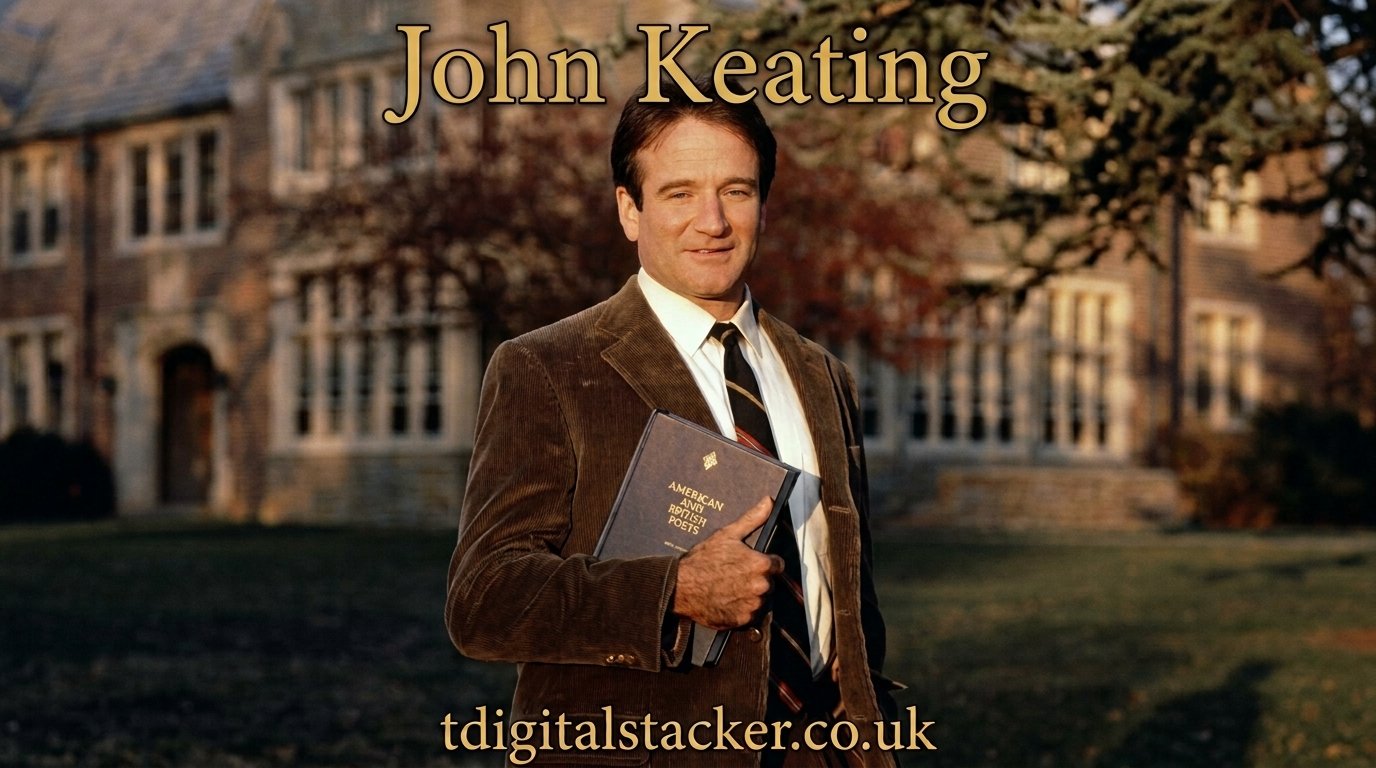
Picture a classroom where students stand on their desks, tear pages out of textbooks, and are told, flat out, to think for themselves. That single image, from a film released in 1989, still shows up in conversations about teaching, mentorship, and personal growth more than three decades later.
The man at the center of that classroom is John Keating, and this post breaks down who he is, what he actually taught, and why his approach to learning and self-expression still holds up today.
Who Is John Keating?
John Keating is a fictional English teacher played by Robin Williams in Dead Poets Society, a 1989 drama directed by Peter Weir. He teaches at Welton Academy, a strict, tradition-bound boys’ boarding school, and quickly becomes known for a style of teaching that clashes with the school’s rigid, exam-focused culture.
Instead of drilling students on rules and rubrics, Keating pushes them to question assumptions, engage with poetry as something lived rather than memorized, and take ownership of how they see the world. He isn’t just a teacher in the story; he becomes a catalyst for how a group of young men start to think about their own choices, ambitions, and identities.
John Keating’s Teaching Philosophy
Keating’s approach can be summed up in a handful of core ideas that run through the entire film.
Living deliberately, not passively. Keating introduces his students to the idea of making the most of the time they have, rather than drifting through school on autopilot. This becomes the emotional backbone of the film and the reason the character is still referenced in discussions about ambition and personal responsibility.
Independent thought over rote learning. In one of the film’s best-known scenes, Keating has students rip a formulaic, overly analytical introduction out of their poetry textbooks, arguing that reducing poetry to a graph or formula strips it of meaning. The lesson isn’t really about poetry alone; it’s about resisting the urge to accept ready-made answers without question.
Poetry and art as necessary, not decorative. Keating treats language and art as tools for understanding life, love, and purpose, not as subjects to memorize for a test. He frames creative thought as something that matters to how people actually live, not just how they perform academically.
Resisting conformity. In the scene where Keating has students walk around the courtyard, he uses their instinct to fall into step with each other as a lesson about how easily individuals give up their own judgment to match the group. It’s one of the clearer, more visual demonstrations of his broader message about thinking independently.
Memorable Ideas and Moments From the Film
Rather than reproducing the film’s dialogue at length, it’s worth highlighting the moments that tend to stick with viewers and get referenced most often:
- The introduction where Keating tells his students to call him “O Captain, my Captain,” pulled from a Walt Whitman poem, setting the tone for an unconventional teacher-student relationship.
- His short, memorable phrase encouraging students to “seize the day,” which became the film’s most quoted line and a shorthand for the character’s entire philosophy.
- The classroom scene where students stand on their desks to see their surroundings differently, literally changing their point of view.
- His argument that words and ideas can change the world, delivered as a counterpoint to the school’s emphasis on practical, career-focused subjects like medicine, law, and business.
These moments matter less as individual lines and more as a pattern: Keating consistently pushes his students toward seeing things from a different angle, whether that’s physically standing on a desk or mentally questioning an assumption they’ve never examined.
Why John Keating Still Resonates Today
The character keeps showing up in conversations well outside film discussion boards, and there are a few clear reasons why.
Education debates. Keating represents a tension that’s still very current: standardized, outcome-driven education versus teaching that prioritizes curiosity, critical thinking, and individual growth. Teachers and education writers regularly reference him when discussing engagement, creativity, or burnout in traditional systems.
Mental health and individuality. The film doesn’t shy away from the cost of conformity and suppressed identity, particularly through the character of Neil Perry. Keating’s message about self-expression is often discussed alongside conversations about mental health, family pressure, and finding one’s own path.
Mentorship culture. Beyond the classroom, Keating is frequently cited as an archetype for mentors and coaches who prioritize a person’s growth over rigid rule-following. His influence can be seen in how later films and shows portray unconventional teacher or mentor figures.
Robin Williams and the Role
Robin Williams brought a specific warmth and unpredictability to Keating that grounded the character’s more idealistic lines in something believable. Rather than playing the role as a speech-giver, Williams leaned into small, human moments: humor, sincerity, and restraint in scenes that could easily have tipped into melodrama.
The performance is frequently cited as one of Williams’ most enduring dramatic roles, standing apart from the comedic work he was best known for at the time, and it remains a reference point when people discuss his range as an actor.
Lessons From John Keating You Can Apply
Keating’s philosophy isn’t limited to a classroom or a specific era.John Keating A few practical takeaways translate directly to how people approach work, learning, and relationships today.
- Question default answers. Before accepting the “standard” way of doing something, ask whether it actually makes sense for your situation, or whether it’s just familiar.
- Make space for creative thinking. Whether it’s writing, music, or any other form of expression, treating it as optional or secondary often means losing a genuine outlet for processing ideas and emotions.
- Notice when you’re following the group. Peer pressure doesn’t always look dramatic. Sometimes it’s as simple as matching everyone else’s pace without asking why.
- Take initiative with your time. Keating’s core message isn’t about recklessness; it’s about being intentional rather than letting time pass by default.
- Look for a different vantage point. Literally or figuratively, changing your perspective on a familiar problem often reveals something a fixed viewpoint misses.
Final Thoughts
John Keating isn’t a real historical figure, but the ideas he represents (independent thought, intentional living, and the value of creative expression) have outlasted the film itself. That’s a large part of why the character keeps coming up in classrooms, mentorship conversations, and personal development content decades after Dead Poets Society first came out.
If there’s one thing worth taking from Keating’s story, it’s this: the specific circumstances of a 1959 boarding school classroom don’t matter nearly as much as the underlying question he keeps asking his students, and by extension, his audience: are you thinking for yourself, or just going along with what’s expected?
