



Introduction
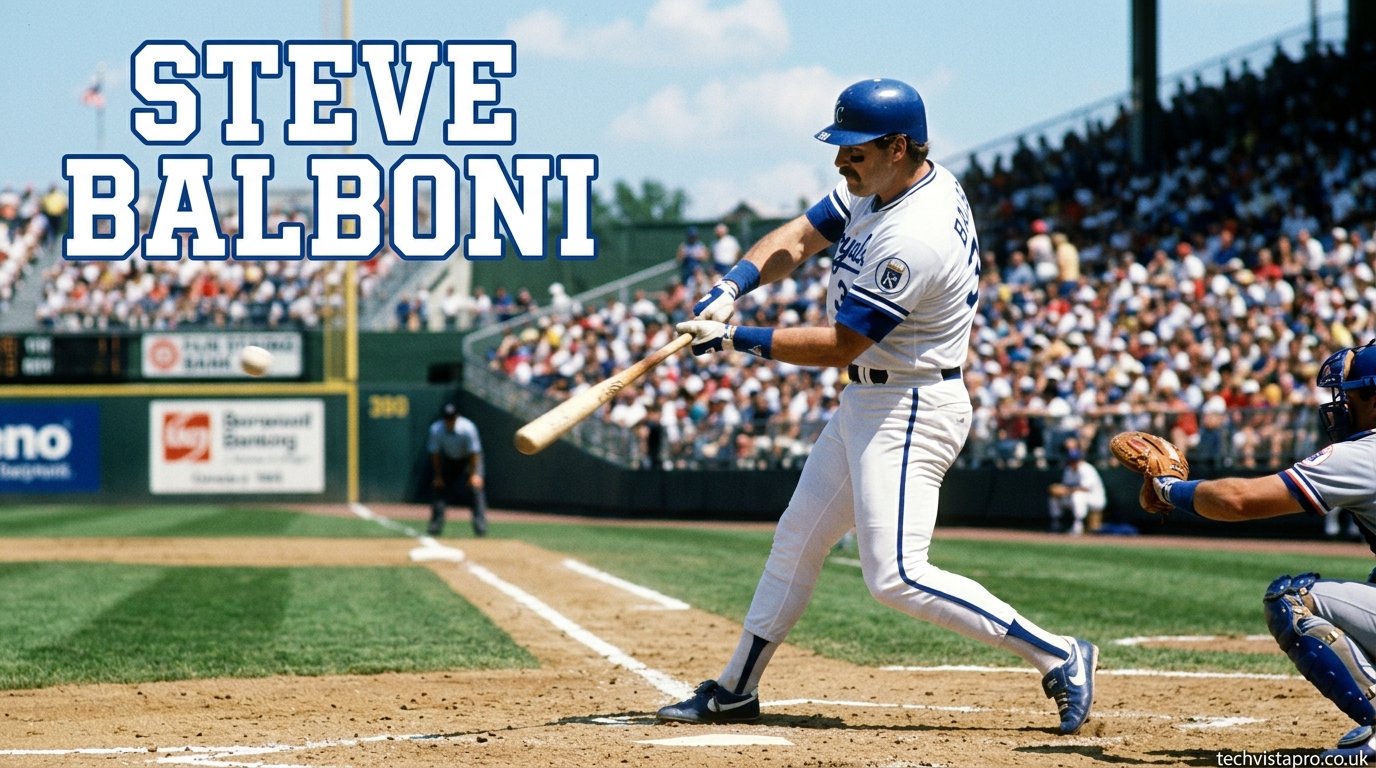
Steve Balboni is a former Major League Baseball player best known for his powerful right-handed swing, high strikeout totals, and ability to hit towering home runs during the 1980s. A first baseman and designated hitter, Balboni played for several MLB teams including the New York Yankees and Kansas City Royals, and became one of the most recognizable “power or strikeout” hitters of his era. His career is often remembered not only for his statistics but also for his role in the 1985 World Series-winning Kansas City Royals team.
Born in Brockton, Massachusetts, Balboni’s journey from college baseball standout to Major League slugger reflects the classic American baseball development path of the late 20th century. With 181 career home runs, a reputation for raw strength, and one of the most debated offensive profiles of his generation, Steve Balboni remains a memorable figure in baseball history.
Early Life and Baseball Beginnings
Stephen Charles Balboni was born on January 16, 1957, in Brockton, Massachusetts, where he developed an early interest in baseball. He later attended Manchester Memorial High School in New Hampshire, where his athletic abilities began attracting attention from scouts and college programs. His physical strength and natural hitting power were evident even before he entered professional baseball.
After high school, Balboni attended Eckerd College in Florida, where his baseball development accelerated significantly. College baseball gave him the opportunity to refine his hitting mechanics and build the foundation for his future power-hitting reputation. His time in collegiate baseball would later become a key stepping stone toward his selection in the professional draft system.
College Baseball and Rise to National Attention
At Eckerd College, Steve Balboni emerged as one of the most dominant hitters in college baseball. His ability to generate home runs and extra-base hits made him a standout player in both regular-season competition and summer leagues. He also played in the Cape Cod Baseball League, where he established himself as one of the premier power hitters in amateur baseball.
During his college years, Balboni led leagues in home runs and RBIs while earning recognition for his offensive production. His performance in summer baseball, especially in prestigious leagues like the Cape Cod Baseball League, significantly boosted his draft stock. Scouts were particularly impressed by his raw strength and ability to drive the ball consistently over long distances, traits that would define his professional career.
Entry into Professional Baseball and Minor League Development
Steve Balboni was drafted by the New York Yankees in the second round of the 1978 MLB Draft, marking the beginning of his professional journey. This selection reflected the Yankees’ belief in his power potential and long-term offensive upside. Once in the minor leagues, Balboni quickly became known for his home run ability but also for his high strikeout rate, a combination that would follow him throughout his career.
In the minors, he put up impressive power numbers, consistently leading leagues in home runs and RBIs while also striking out frequently. His development path included multiple seasons of refining his approach at the plate, adjusting to higher-level pitching, and learning how to balance aggression with consistency. Despite the strikeouts, his power production kept him in strong consideration for a major league call-up.
His minor league performance created a reputation as a classic “power hitter prospect,” someone capable of changing games with a single swing but still needing adjustment at the plate to succeed in the majors.
MLB Debut and Early Career with the Yankees
Steve Balboni made his Major League debut with the New York Yankees on April 22, 1981. Entering one of baseball’s most high-pressure franchises, he faced immediate expectations as a developing power hitter. During his early years with the Yankees, he struggled to maintain consistent batting averages but showed flashes of the power that had defined his minor league success.
His role with the Yankees was often limited due to competition within the roster and the team’s need for more consistent offensive production. Despite this, Balboni remained a valuable depth option, especially in situations requiring power hitting. His time in New York provided him with important experience but also revealed the challenges he would face in becoming an everyday MLB starter.
As his early career progressed, it became clear that his future success would depend on finding a team willing to accept both his power output and his high strikeout tendencies.
Kansas City Royals Breakthrough and Career Peak
Steve Balboni’s career reached its peak after joining the Kansas City Royals, where he became a key part of their lineup in the mid-1980s. It was in Kansas City that he developed his identity as a full-time power hitter and established his most productive MLB season.
His most notable year came in 1985, when he hit 36 home runs and set a franchise record for the Royals. That same season, he led the American League in strikeouts, highlighting the extreme nature of his offensive profile. Despite the high strikeout total, his power production made him a crucial part of the Royals’ offensive strategy.
Balboni’s contributions helped the Royals reach the postseason and ultimately win the 1985 World Series, one of the most significant achievements of his career. In the championship series, he played an important role with key hits and solid defensive work at first base, contributing to Kansas City’s victory over the St. Louis Cardinals.
Playing Style, Strengths, and On-Field Identity
Steve Balboni’s playing style was defined by raw power, aggressive swings, and a willingness to take risks at the plate. He was not known for a high batting average, but his ability to hit home runs made him valuable in specific offensive situations. His approach reflected the traditional “three outcomes” style of power hitters: home run, strikeout, or walk.
Defensively, Balboni played primarily at first base and occasionally served as a designated hitter. While his offensive consistency varied, he was considered reliable in fielding his position. His physical presence and strong throwing arm contributed to his defensive value.
Fans and analysts often described him as a classic “all-or-nothing” hitter, someone who could dramatically change a game with one swing but also struggle with consistency over long stretches.
Later Career and Final MLB Seasons
After his successful run with the Royals, Steve Balboni continued his MLB career with several teams, including the Seattle Mariners and a return to the New York Yankees. His later years in the league reflected a transition into a veteran role, where he provided experience and occasional power production rather than everyday offensive output.
By the early 1990s, Balboni’s time in Major League Baseball was nearing its end. His final MLB appearances came with the Texas Rangers in 1993, marking the conclusion of a career that spanned over a decade in the big leagues. Even in his final seasons, he remained capable of contributing offensively in limited opportunities.
His career totals included 181 home runs, 495 RBIs, and over 700 hits, numbers that reflect both his power-hitting identity and his long tenure in professional baseball.
Legacy, Statistics, and Cultural Impact
Steve Balboni’s legacy in baseball is often discussed in the context of his unique statistical profile. With a career batting average of .229 and 181 home runs, he represents one of the clearest examples of a power-first hitter in modern baseball history. His strikeout totals were high, but so was his ability to deliver game-changing home runs.
He also became part of baseball folklore through references such as the “Curse of the Balboni,” a statistical concept suggesting that teams relying too heavily on a single 30+ home run hitter struggled to win championships. While not an official rule, it contributed to his lasting recognition among baseball analysts and fans.
Beyond statistics, Balboni is remembered for his role in the 1985 Royals championship team and for his reputation as a player who embodied the risk-and-reward nature of power hitting during the 1980s.
Conclusion
Steve Balboni’s baseball career reflects the story of a player defined by power, persistence, and a distinctive offensive style. From his early days in Massachusetts to his rise in college baseball, his development in the minor leagues, and his peak years with the Kansas City Royals, he built a career that left a lasting impression on Major League Baseball.
Although his batting average and strikeout totals often overshadowed his achievements, his 181 career home runs and contribution to a World Series-winning team ensure his place in baseball history. Today, Steve Balboni is remembered not only as a power hitter of his era but also as a symbol of baseball’s long-standing fascination with home run hitters and their impact on the game.
